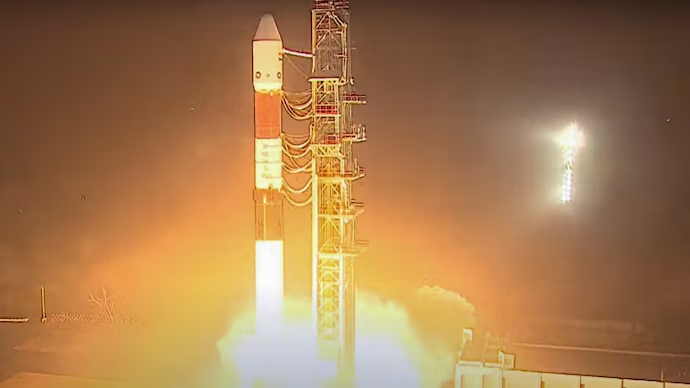
Sriharikota, May 18 – The Indian Space Research Organisation (ISRO) encountered a setback on Sunday as the PSLV-C61 mission failed to place the EOS-09 Earth observation satellite into its intended orbit. The launch took place from the Satish Dhawan Space Centre in Sriharikota.
The mission marked the 63rd flight of the Polar Satellite Launch Vehicle (PSLV) and the 27th in its XL configuration. It was tasked with deploying the EOS-09 satellite into a sun-synchronous polar orbit, a crucial placement for Earth observation missions.
Initial phases of the launch proceeded as planned, with the first and second stages performing nominally. However, ISRO Chairman V. Narayanan revealed that the third stage, a solid motor system critical for achieving orbital velocity, experienced an anomaly.
“The PSLV is a four-stage vehicle. Up to the second stage, the performance was normal. The third stage motor ignited as expected, but during its operation, we observed a drop in chamber pressure. As a result, the mission could not be accomplished,” Narayanan said during the post-launch broadcast.
He further noted that a detailed analysis is underway to determine the exact cause of the anomaly. “We are closely studying the vehicle’s performance and will share our findings at the earliest,” he added.
The PSLV-C61 mission was ISRO’s 101st launch from Sriharikota, underscoring the high reliability of the PSLV series despite this rare failure. The incident marks a reminder of the complexities and challenges inherent in space missions.