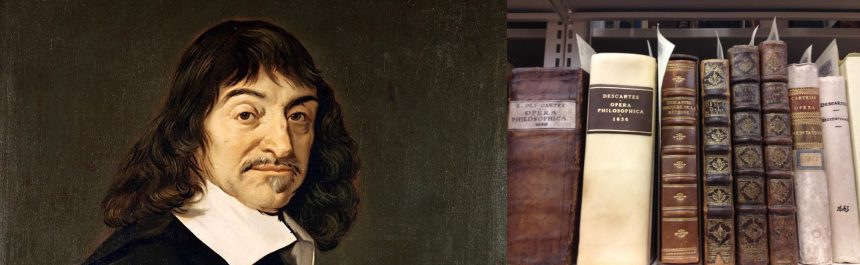
René Descartes was a French philosopher, mathematician, and scientist, but his contributions to philosophy have largely overshadowed his other achievements. Hailed as the father of modern philosophy, he lived during a time of great intellectual upheaval. A contemporary of Francis Bacon and Galileo and a predecessor to Isaac Newton, Descartes carved an eminent place in history through his revolutionary ideas.
His first significant philosophical work, Discourse on Method, was originally written in French. In this book, Descartes embarked on a journey of reason, aiming to uncover truth and eliminate error. This was followed by Meditations on First Philosophy (1641), written in Latin, and later by The Principles of Philosophy (1644) and The Passions of the Soul (1649).
Despite his expertise in physics and mathematics, Descartes believed the foundation of all human knowledge could only be established through metaphysics. He likened knowledge to a tree, with metaphysics as its roots and physics as the trunk. For Descartes, truth could not be based on assumptions but had to be built on indubitable principles. To achieve this, he introduced a method of systematic doubt—rejecting preconceived beliefs and accepting only those ideas that could withstand rigorous reasoning.
To illustrate this approach, he compared knowledge to a basket of apples. To ensure only sound beliefs remain, one must empty the basket and examine each apple carefully, discarding any that are rotten—just as one must discard faulty premises in the pursuit of truth.
The Arguments for Doubt
Descartes identified two key arguments that justified radical doubt.
1. The Dreaming Argument
Imagine you are sitting in a chair, holding a newspaper. You feel certain of your surroundings, trusting your senses to affirm reality. But Descartes asks: could you be dreaming? In dreams, we experience sensations just as vividly as we do when awake. How, then, can we know that this moment isn’t part of a dream? If our senses can deceive us in dreams, they may also deceive us in waking life. Thus, sense perception cannot be relied upon as an absolute path to truth.
2. The Evil Genius Argument
Descartes takes skepticism further by proposing a hypothetical scenario: what if an all-powerful, malevolent being—a so-called “Evil Genius”—was manipulating our perceptions and beliefs, deceiving us into accepting falsehoods as truth? Even seemingly self-evident facts, like “2 + 3 = 5” or “a square has four sides,” could be illusions implanted by this deceiver. Though improbable, this possibility cannot be conclusively disproven, introducing doubt even into the realm of mathematics and logic.
Cogito, Ergo Sum: The Indubitable Truth
After systematically doubting everything, Descartes sought a single truth that could not be questioned. He imagined that everything—his country, his house, even his body—might not exist. But one thing remained undeniable: the very act of doubting required a thinker. If he was doubting, then he must exist.
Thus, Descartes arrived at his most famous conclusion: Cogito, ergo sum—“I think, therefore I am.”
This statement is self-verifying. One cannot doubt their existence without first existing to entertain the doubt. Even the claim “I do not exist” contradicts itself, for making such a statement requires existence. Descartes concluded that while we can doubt everything—including our physical attributes and sensory experiences—the ability to think is undeniable. Thinking, he argued, is the essence of existence.
The Existence of God
Some might assume Descartes’ method of doubt leads to atheism or agnosticism. However, he used rationalism to argue for the existence of God.
As a thinking being, Descartes recognized his own imperfection—evidenced by his capacity to doubt and his lack of complete knowledge. Yet, within his mind, he held the idea of a most perfect being: God. He reasoned that such an idea could not have originated from his imperfect self; it must have been placed there by a perfect being. Furthermore, he argued that every effect must have a cause, and since the idea of God is an effect, its cause must be a being that is itself perfect—God.
Relevance in the 21st Century
In an era dominated by science and technology, some may view Descartes’ philosophy as outdated. Yet, his ideas remain foundational, shaping modern science, mathematics, and epistemology. His method of doubt laid the groundwork for scientific skepticism and critical inquiry. The Cartesian emphasis on rationalism continues to inspire philosophers, scientists, and thinkers across disciplines.
Descartes’ legacy is like an old, weathered monument—time-worn, yet standing firm against intellectual complacency. His philosophy challenges us to think deeply, question boldly, and seek clarity in our understanding of the world.
(The Author can be reached at owais90gora@gmail.com )