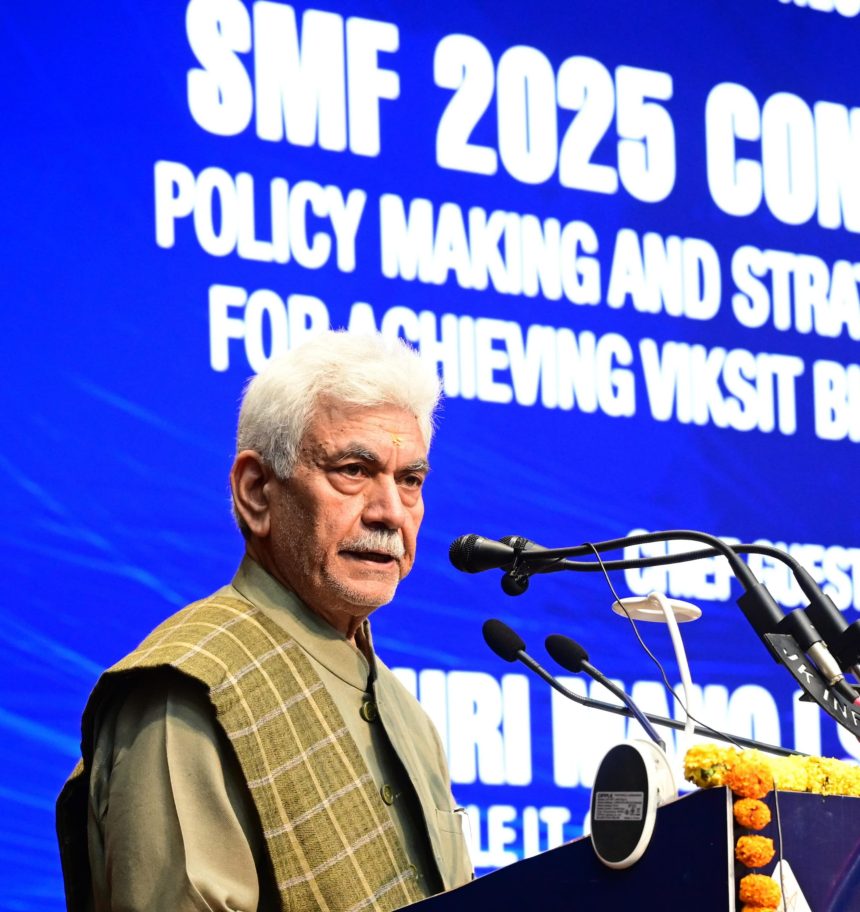
Jammu, Dec 17 (KNS): Lieutenant Governor Manoj Sinha on Wednesday emphasized the need for a strong, people-centric policy framework to achieve the vision of Viksit Bharat by 2047, while addressing the Strategic Management Forum Conference at IIM Jammu.
The three-day conference is being organised by IIM Jammu in collaboration with the Strategic Management Forum and NITI Aayog.
In his keynote address, the Lieutenant Governor highlighted macroeconomic stability, investment in education and health, digital tools, transparency, participatory governance, and efficient public service delivery as key drivers of inclusive development. He stressed that policies must reflect the needs of people, industry, trade, and business while maintaining a balance between industrial growth and social welfare.
LG Sinha said India’s rapid growth under Prime Minister Narendra Modi’s leadership is unprecedented, noting strong performance in manufacturing, services, village industries, handloom, and handicrafts, boosted by the Swadeshi initiative. He underlined that inclusive and equitable growth, job creation, support for small businesses, and financial empowerment remain central to government policy.
He reaffirmed commitment to ensuring that initiatives like Digital India reach the last mile and said decentralized governance has brought significant positive change.
Highlighting Jammu and Kashmir’s economic potential, the Lieutenant Governor called for tapping the underutilized mining sector, stating it could generate an additional annual revenue of ₹15,000–20,000 crore in the next 5–7 years. He also stressed maximizing hydropower potential and revising the Holistic Agriculture Development Programme to meet evolving needs.
LG Sinha said the “insider-outsider” narrative hampers development and must end, and asserted that terrorism in the region will be eliminated.
On the occasion, he unveiled the Basohli Painting Exhibition and felicitated artists, calling Basohli Painting a priceless cultural heritage.
The event was attended by senior officials, policymakers, academicians, industry leaders, artists, and students.