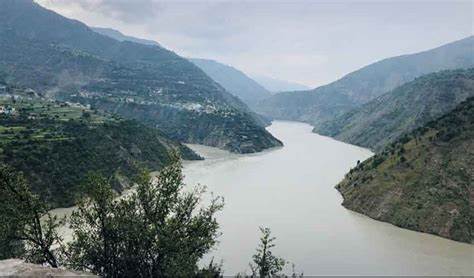
In a move laden with diplomatic overtones, India has significantly reduced the flow of water to Pakistan through the Baglihar Dam on the Chenab River, following the deadly terrorist attack in Pahalgam on April 22 that claimed 26 lives. Officials cited both operational needs and a shift in political posture as reasons for the action.
The sluice gates of the Baglihar Dam, located in Jammu’s Ramban district, were briefly opened for routine de-silting operations but were shut again on the morning of May 4, effectively halting the release of water downstream into Pakistan’s Punjab region. Images of a parched Chenab riverbed at Ramban have underscored the dramatic impact of the gate closure.
A senior Indian government official, speaking to The Indian Express, said the step is part of a broader strategy to exert pressure on Pakistan. “Even if this restriction is temporary, it signals our intent to respond firmly across all fronts. Pakistan must understand that provocations will have consequences,” the official stated.
The move coincides with India’s decision to suspend the Indus Waters Treaty (IWT), a landmark agreement brokered by the World Bank in 1960, which has governed the sharing of river waters between the two nations. Under normal circumstances, India would have notified Pakistan of such reservoir operations. However, with the treaty effectively placed in abeyance after the recent terror attack, New Delhi opted not to issue any prior communication.
The Baglihar Dam has long been a point of contention between India and Pakistan. Although classified as a run-of-the-river project with limited storage capacity—475 million cubic metres, approximately twenty times smaller than the Bhakra Dam in Himachal Pradesh—it holds strategic importance due to its ability to control the timing and volume of water released downstream.
Officials maintain that the immediate reason for the dam’s closure was sediment removal, a routine necessity given the fragile geological composition of the region. The surrounding terrain is made up of weathered and fissile rock formations, including shale, phyllite, and slate, which contribute to frequent sediment build-up in the reservoir that powers a 900-megawatt hydroelectric plant.
Sources also hinted that similar measures are being considered at the Kishanganga hydroelectric project on the Jhelum River in north Kashmir, potentially opening another front in India’s evolving water diplomacy.