SRIHARIKOTA (Andhra Pradesh), Nov 2 (PTI):
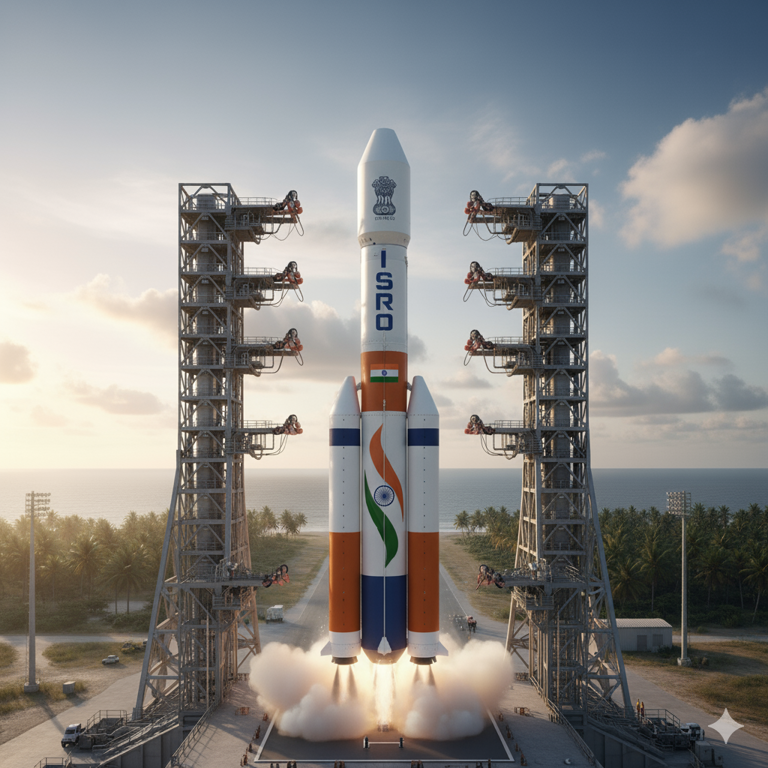
The Indian Space Research Organisation (ISRO) is poised to create another milestone today as it prepares to launch its heaviest-ever satellite onboard an Indian-built rocket. The heavy-lift LVM3-M5 vehicle, also known as ‘Bahubali’ for its power and size, will carry the 4,410-kg communication satellite CMS-03 into a Geosynchronous Transfer Orbit (GTO) at 5:26 pm from the Satish Dhawan Space Centre here.
According to ISRO officials, the 24-hour countdown, which began on Saturday evening, is “progressing smoothly.” The space agency confirmed that the fully assembled launch vehicle has been integrated with the spacecraft and positioned at the second launch pad for final pre-launch checks.
“This will be the heaviest satellite to be launched from Indian soil and into a GTO using an indigenous rocket,” an ISRO spokesperson said.
Until now, ISRO has relied on the France-based Arianespace’s Ariane rockets to launch communication satellites weighing over 4,000 kg. The heaviest of these was GSAT-11, launched in December 2018 aboard an Ariane-5 VA-246 rocket from French Guiana, weighing 5,854 kg.
The LVM3-M5, standing 43.5 metres tall, represents India’s growing self-reliance in space technology. The three-stage vehicle includes two solid rocket boosters (S200), a liquid propellant core stage (L110), and a cryogenic upper stage (C25). These systems were developed at ISRO’s Vikram Sarabhai Space Centre, Thiruvananthapuram, and the Liquid Propulsion Systems Centre.
LVM3, also known as the Geosynchronous Satellite Launch Vehicle (GSLV) Mk III, is capable of carrying payloads weighing up to 4,000 kg to GTO and 8,000 kg to Low Earth Orbit (LEO). This marks the fifth operational flight of the LVM3 series.
The satellite, CMS-03, is a multi-band communication satellite designed to provide services across the Indian subcontinent and adjoining oceanic regions. While some reports suggest potential defence applications, ISRO has not officially confirmed this.
“The CMS-03 satellite will enhance communication services over a wide oceanic region, including the Indian landmass,” ISRO stated.
The previous LVM3 mission, Chandrayaan-3, scripted history in 2023 when India became the first nation to achieve a successful soft landing near the lunar south pole.
With today’s launch, ISRO continues its mission of advancing India’s space capabilities and strengthening indigenous technology for heavy-lift operations.